Rosedil Review: An Honest Look at the Rosemary Hair Capsule
Rosedil is a nighttime capsule built around rosemary extract and marketed to women with thinning hair. Here is what the evidence actually supports.
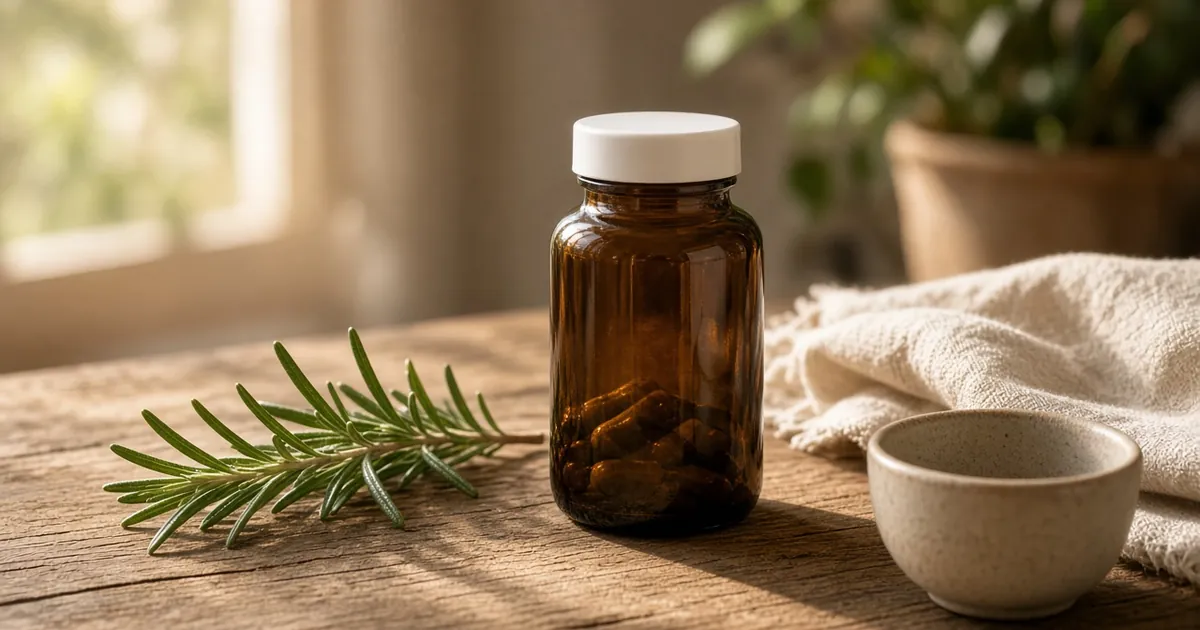
Rosedil rides a big wave: rosemary for hair has become one of the most popular wellness trends online. The product is sold through a long sales video that frames it as a "rosemary trick" and is highly critical of conventional treatments. Our goal here is to set the marketing aside and look at what is actually known.
How we wrote this review: we have not tested Rosedil ourselves and did not receive free product. This review is based on the seller's published product information and the independent research and health sources linked throughout. We do not repeat testimonials, celebrity names, statistics or result timelines from the sales video. See our editorial policy.
What Rosedil is
According to the seller, Rosedil is a capsule taken at night, sold in bottles of 60 capsules and labeled for hair support. It is marketed to women noticing more hair in the drain, a widening part or a thinner ponytail, including women in menopause and women who noticed shedding after rapid weight loss.
The seller lists four main ingredients:
- Concentrated rosemary extract, highlighted for its carnosic acid content
- Japanese green tea extract
- Curcumin with gingerol (compounds from turmeric and ginger)
- Hydrolyzed type 1 collagen (gelatin)
We could not confirm the amount of each ingredient per capsule from the materials we reviewed. Check the Supplement Facts panel before buying.
The ingredients and the evidence
Rosemary
Most of the excitement about rosemary for hair traces back to a single 2015 randomized trial. In it, 100 people with pattern hair loss applied either rosemary oil or 2% minoxidil to the scalp for six months. Both groups had increased hair counts at six months, with no significant difference between them, and scalp itching was less common with rosemary.
That is a genuinely interesting result, but it has limits: the study was small, had no placebo group and has not been widely replicated. Most importantly for this review, it tested rosemary oil applied to the scalp, not rosemary taken by mouth. We are not aware of good-quality human trials showing that oral rosemary extract helps hair growth. Read more in rosemary for hair: what we know so far.
Bottom line on rosemary: promising as a topical oil in one small trial; unproven as a capsule.
Green tea extract
Green tea compounds have been studied in the lab for effects on hair follicles, but human evidence for hair growth is limited. There is also an important safety note: the National Center for Complementary and Integrative Health reports that green tea extract supplements have been linked with rare cases of liver injury, even though drinking green tea is generally considered safe.
Bottom line on green tea extract: limited evidence for hair; a small but real liver safety concern.
Curcumin and gingerol
Curcumin, from turmeric, is studied mainly for its anti-inflammatory properties. Evidence that oral curcumin helps hair growth in people is limited. NCCIH notes that turmeric supplements have been associated with rare cases of liver injury and may interact with some medications, and that people with gallbladder disease should be cautious. Gingerol from ginger has little human research for hair.
Bottom line on curcumin and gingerol: limited evidence for hair; check interactions.
Hydrolyzed collagen (gelatin)
Collagen supplements have some evidence for skin hydration and elasticity, as Harvard's Nutrition Source discusses, but research on hair is much more limited. Hair is made mainly of keratin, a different protein.
Bottom line on collagen: generally safe; evidence for hair is weak.
What we like
- Rosemary is an interesting ingredient with at least some research behind it, even if that research tested topical oil.
- Simple routine: one nighttime capsule, according to the seller.
- A 60-day money-back guarantee is advertised, which lowers the financial risk if you read and follow the refund terms.
- One-time payment, according to the seller. Confirm at checkout.
What gives us pause
- The marketing overreaches. The sales video presents a sweeping theory of hair loss and dismisses established treatments. The FTC requires health claims to be backed by competent and reliable scientific evidence. We did not find published trials of Rosedil itself.
- It discourages proven care. Topical minoxidil is FDA-approved for female pattern hair loss, and the American Academy of Dermatology describes it as a treatment that can help. Skipping a proven option for an unproven one can mean losing time and hair.
- The key rosemary study does not apply to capsules.
- Two ingredients carry rare liver risks in supplement form (green tea extract and turmeric).
- Dose transparency. We could not verify per-capsule amounts.
- Cost. At the seller's listed prices, a six-month supply is a significant expense for an unproven product.
- Supplements are not pre-approved. The FDA does not review supplements for safety or effectiveness before they are sold.
Get the diagnosis first
Hair thinning has many possible causes, from female pattern hair loss to thyroid problems, low iron, medications and temporary shedding after stress, illness or rapid weight loss. Mayo Clinic outlines the range. Shedding after a major stressor often settles on its own within months, as the AAD explains. No supplement can fix thinning caused by an untreated thyroid problem or iron deficiency. Our guides to hair thinning after 40 and shedding versus hair loss can help you sort it out.
Who might consider it
- Women who have had their hair loss evaluated, understand the evidence is limited, and want to try a rosemary-based supplement alongside, not instead of, advice from their dermatologist
- People comfortable with the cost and willing to track results honestly with monthly photos
Who should skip it, or ask a clinician first
- Anyone who is pregnant or breastfeeding
- People with liver disease or a history of liver problems
- People with gallbladder disease or gallstones (turmeric)
- People taking blood thinners, diabetes medications or other medications that may interact with turmeric or green tea extract
- People with sudden, patchy or rapid hair loss, or scalp pain, redness or scaling, who need a dermatologist first
- Anyone planning surgery
Stop taking it and seek medical care if you notice yellowing of the skin or eyes, dark urine, abdominal pain or unusual fatigue.
Price, guarantee and how to buy safely
According to the seller's offer information at the time of writing, Rosedil was listed at about $79 per bottle for a 2-bottle kit (plus shipping), about $69 per bottle for 3 bottles and about $49 per bottle for 6 bottles with free U.S. shipping, with a 60-day money-back guarantee. Prices can change, so the checkout page is the final word.
Before you order:
- Read the full Supplement Facts panel and check every ingredient against your medications.
- Confirm the total price, shipping and whether any add-ons are pre-selected.
- Read the refund terms carefully: the time window, whether opened bottles qualify and how to request a refund.
- Keep your order confirmation and the seller's contact details.
- Buy only through the official checkout.
The ODS guide Dietary Supplements: What You Need to Know and our supplement checklist are good preparation.
Alternatives worth considering
- A dermatologist visit to identify the cause of thinning.
- Topical minoxidil, FDA-approved for female pattern hair loss.
- Topical rosemary oil, diluted and patch-tested, if you want to try the form that was actually studied.
- Testing for iron, thyroid and other causes through your clinician.
- Gentle hair care and a diet with enough protein.
Frequently asked questions
Does Rosedil work for hair loss?
We are not aware of published studies on Rosedil itself. Its headline ingredient, rosemary, showed promise as a topical oil in one small trial, but evidence for rosemary taken by mouth is lacking, and the other ingredients have limited evidence for hair.
Is Rosedil safe?
Many people tolerate these ingredients, but green tea extract and turmeric supplements have been linked with rare liver injury, and turmeric can interact with some medications. Talk to your clinician first, especially if you have liver or gallbladder problems, take medications or are pregnant.
Is Rosedil better than minoxidil?
There is no evidence to support that. Minoxidil is FDA-approved for female pattern hair loss and has been studied for decades. The rosemary study often cited compared topical oil, not a capsule, with 2% minoxidil.
How much does Rosedil cost?
At the time of writing, the seller listed about $79 per bottle for 2 bottles, $69 for 3 and $49 for 6. Check the checkout page for current prices.
Where can I buy Rosedil?
Through the seller's official checkout. Our Rosedil offer page lists the 2, 3 and 6-bottle packages with links to the official checkout.
Sources
- Panahi Y, et al. Rosemary oil vs minoxidil 2% for the treatment of androgenetic alopecia: a randomized comparative trial. Skinmed. 2015 PubMed
- Hair loss in women: Female pattern hair loss American Academy of Dermatology
- Do you have hair shedding or hair loss? American Academy of Dermatology
- Hair loss: Symptoms and causes Mayo Clinic
- Green Tea National Center for Complementary and Integrative Health (NIH)
- Turmeric National Center for Complementary and Integrative Health (NIH)
- Collagen The Nutrition Source, Harvard T.H. Chan School of Public Health
- Dietary Supplements U.S. Food and Drug Administration
- Health Products Compliance Guidance Federal Trade Commission
- Dietary Supplements: What You Need to Know NIH Office of Dietary Supplements